
Emily Braun
On the “Spirit of Gravity” in the Art of Giorgio de Chirico
Abstract:
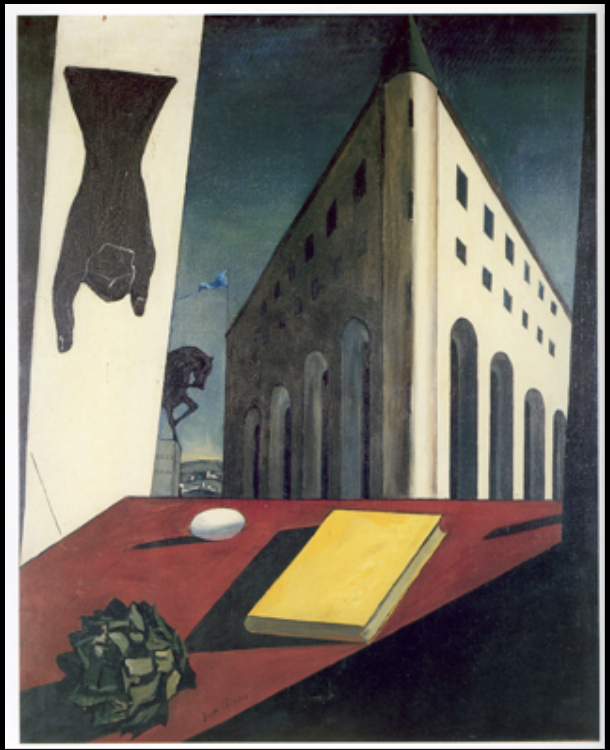
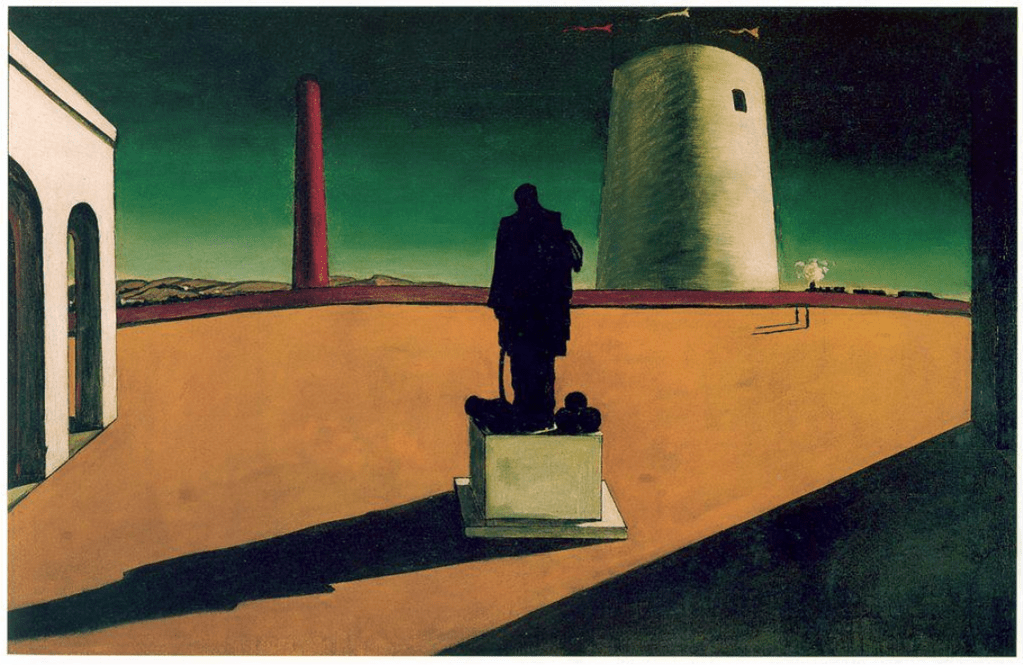
In the years around World War I, the European avant-garde destroyed the foundations of Western painting by moving away from naturalistic depiction and solidity of form toward the immaterial. Aviation was invented at the same time. By contrast, the anomalous paintings of Giorgio de Chirico were filled with signs of gravity and gravitas, with the weightiness of mass –and of meaning. Structures, objects, shadows – even atmosphere – read as heavy and somber. Yet de Chirico’s strategies of representation deliberately play with proprioception to reveal that little in our world view is grounded. This essay probes a key aspect of Friedrich Nietzsche’s influence upon de Chirico’s metaphysical art (“beyond the physical”), namely, his attack on logocentrism through his parodic “spirit of gravity.”
Biography:
Emily Braun is Distinguished Professor, Hunter College and the Graduate Center, CUNY. An historian of modern European and American art, cubism, and the culture of the Fascist period, she has curated Alberto Burri: The Trauma of Painting (Solomon R. Guggenheim Museum, 2015); and co curated The Power of Conversation: Jewish Women and their Salons (The Jewish Museum, 2005) and Cubism and the Trompe l’Oeil Tradition (The Metropolitan Museum of Art 2023) among other exhibitions. Her work has been recognized by the Henry Allen Moe Prize, the American Association of Museum Curators, the Dedalus Foundation, and a National Jewish Book Award. She is a recipient of Fellowships from the Getty Foundation and the Dorothy and Lewis B. Cullman Center for Scholars and Writers at the NYPL. Since 1987 she has curated The Leonard A. Lauder Collection.
 Home
Home 