
Subhashini Kaligotla
Kumbhakarna’s Fall and Rise in the Mewar Ramayana
Abstract:
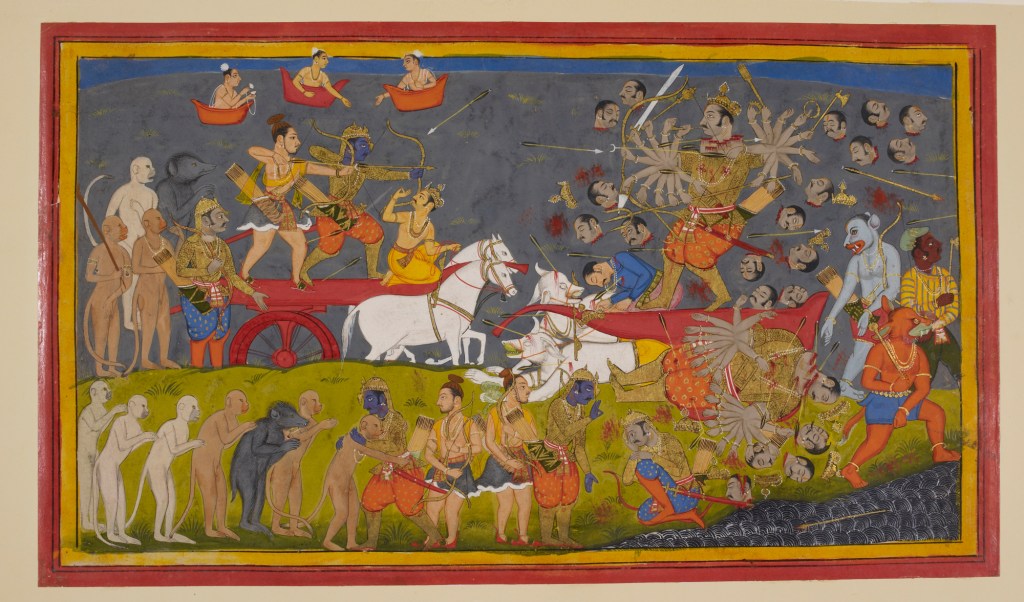
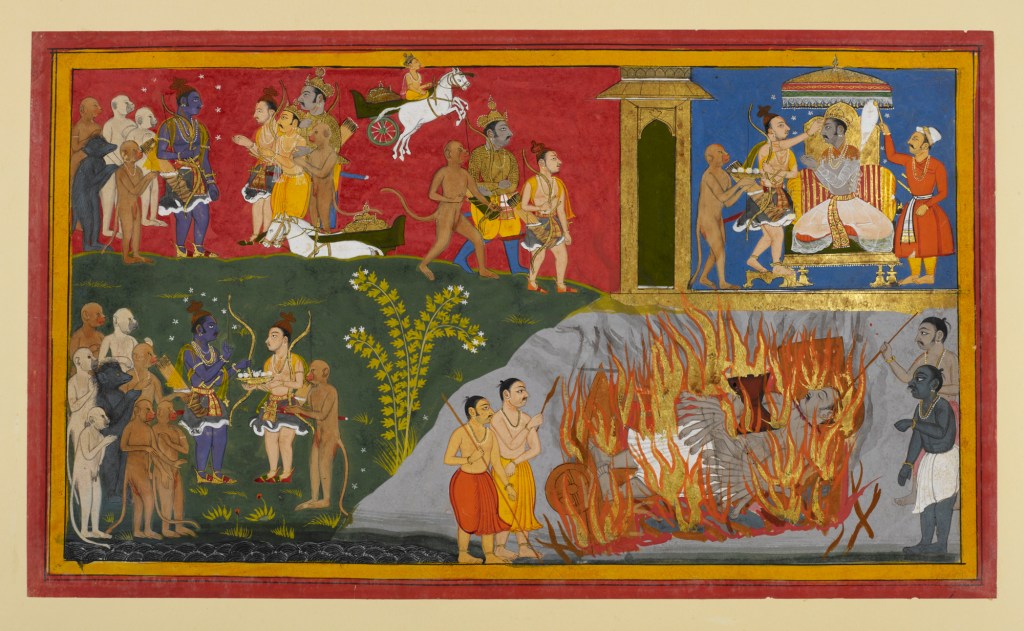
Known for their prodigious taste for food, sex, violence, and human flesh, rakshasas— “demons”—are the epic Ramayana’s anti-heroes. Kumbhakarna is one such—enormous in both appetite and strength. The mid-seventeenth century Mewar Ramayana brings Kumbhakarna to life in pictorial frames barely containing the giant, and his dismemberment and death can be counted among the royal western Indian manuscript’s most dynamic and poignant scenes. Woken from a long sleep so that he could fight the tale’s hero, god-king Rama, Kumbhakarna battles fearlessly to his death in a war that is not his out of loyalty for his brother. Drawing attention to the manuscript’s extravagant use of goldleaf, its swirling repetition of Kumbhakarna’s form, and his gravity-defying limbs, the essay argues that painters lifted Kumbharkana to the realm of the heroic even as Rama severed one limb after another and Kumbharkana crashes to his end.
Biography:
SUBHASHINI KALIGOTLA is a poet and art historian of premodern South Asia. She is the Barbara Stoler Miller Associate Professor of Indian and South Asian Art at Columbia University. Her first book, Shiva’s Waterfront Temples: Architects and their Audiences in Medieval India (Yale University Press, 2022), centered on the ingenuity of Deccan India’s creators. Her current book project, Seeing Ghosts, is a life story of the dead, from the moment of death to passage into the afterlife, told with art historical media.
 Home
Home 